The phone that corrects you
Nearly every adult in North Korea now carries a smartphone. It is a Chinese handset running a modified Android, and it has been rebuilt so thoroughly that the interface itself is an argument: every label on it is a Northern word, chosen against a Southern one. Then, in the messaging app, the argument stops being passive. Type a Southern word and the phone rewrites it while you watch. About twenty minutes, and every claim is sourced.
The two Korean standards have been drifting apart since 1945, and the usual way to teach that is a table of word pairs. The trouble with a table is that it presents the divergence as something that happened, quietly, over decades. It did not only happen. Since 2023 it has been manufactured, enforced and prosecuted, and the enforcement now runs inside consumer software. A phone shows you the finished state and the machinery in the same object.
So this deck teaches the linguistics through the device rather than alongside it. You will read an application drawer in Munhwaeo and work out the Southern equivalents yourself; you will meet the file-signature system that decides which media may open at all; and you will type into a message box that will not accept what you typed. The vocabulary you leave with is real vocabulary. The architecture around it is the reason that vocabulary looks the way it does.
The screen you are handed
In June 2025 the BBC filmed a handset that had been smuggled out of North Korea, a Samtaesong model, and held the application drawer to camera long enough to read every label on it. That single frame is the most useful Korean-language teaching object this project has found, because almost every icon on it carries a word that the South does not use.
Start by reading the drawer. Marked icons open an annotation.
The drawer, read closely
Reconstructed from a photograph. Labels are as read from the footage; anything that could not be read cleanly has been left out rather than guessed.
Select any icon with a gold ring. Each one carries a word that differs from the Southern form, and the annotation names the rule behind the difference.
Now do it without the answers
Pick a word, decide what a Seoul phone would call it, then reveal. Nine of these follow rules you can state; the tenth is just a different choice of word, which is its own lesson.
What a drawer of words is evidence of
The clearest measure of relative success is the mobile phone itself. The North's native coinage 손전화, "hand phone", displaced the loanword; the South still says 휴대폰 and 핸드폰. In the other direction, the North's 1980s coinage 얼음보숭이 for ice cream never displaced 아이스크림 in ordinary speech, so the campaign's own record is uneven and the deck should not overstate it.
Sources used in this module: BBC footage of a smuggled Samtaesong handset, 3 June 2025, read from still frames, syndicated by Fortune (4 June 2025) and Asia Economy (3 June 2025); 최재필, "[이슈분석] 北 스마트폰, 통보문·화상서고를 아십네까?", ETNews, 9 October 2018, for the North-South interface vocabulary table; 노정민, RFA Korean, 30 October 2015, for the earlier Pyongyang-handset home screen; the rules themselves from this project's Korean language variation taxonomy and its sources.
What the phone requires of you
Module 01 read the surface. Underneath it sits an architecture that security researchers have taken apart twice: once on a tablet in 2016, and again on handsets in 2022 and 2024. Three mechanisms do most of the work. Every file must prove where it came from; the phone photographs its own screen and shows you that it has; and the price of being connected is paid in foreign currency.
Every file has to prove itself
Select a file to run the check.
Three files arrive on the phone: one from a state source, one the phone made itself, one from a stranger's memory card. Only two of them will open.
열람리력 · the log you cannot clear
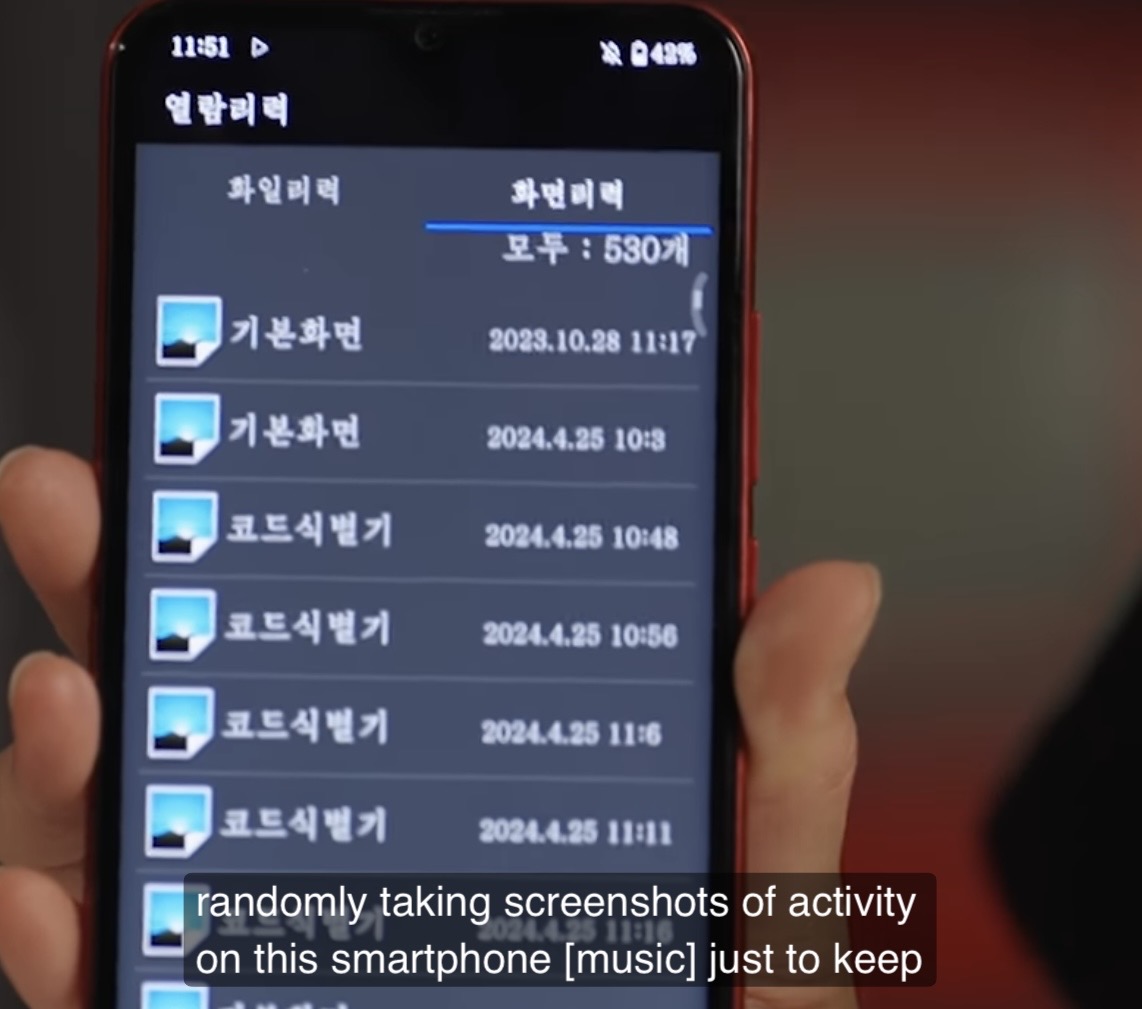
The phone screenshots itself, and tells you so. Researchers who examined North Korean devices found a standard feature that captures the screen during use and records which application was open at the time. The user can see the timestamp and the application name for every capture. The user cannot view the images, and cannot delete them. They can be exported for an official to inspect.
A visible log can also deter: the user is reminded that activity leaves a record. That is an interpretation of the design, distinct from the observed capture and storage behaviour. Try the two buttons.
Note the app name itself: 열람리력, where Southern orthography would give 열람 이력. The initial sound rule is doing work in the name of the surveillance feature.
Read the record
The simulation becomes a source you can inspect. Choose a frame, then a gold marker or a Korean label. Turn on the English gloss for help.
Where this evidence begins and ends
These are supplied still frames of a Haeyang 701 demonstration. The player controls and subtitles belong to the recording, not the phone. The phone’s own history dates are visible in its list; they do not identify its original owner, establish where it was used, or authenticate the clock.
The handset is labelled 해양 701. Its Android software is distinct from Red Star OS.
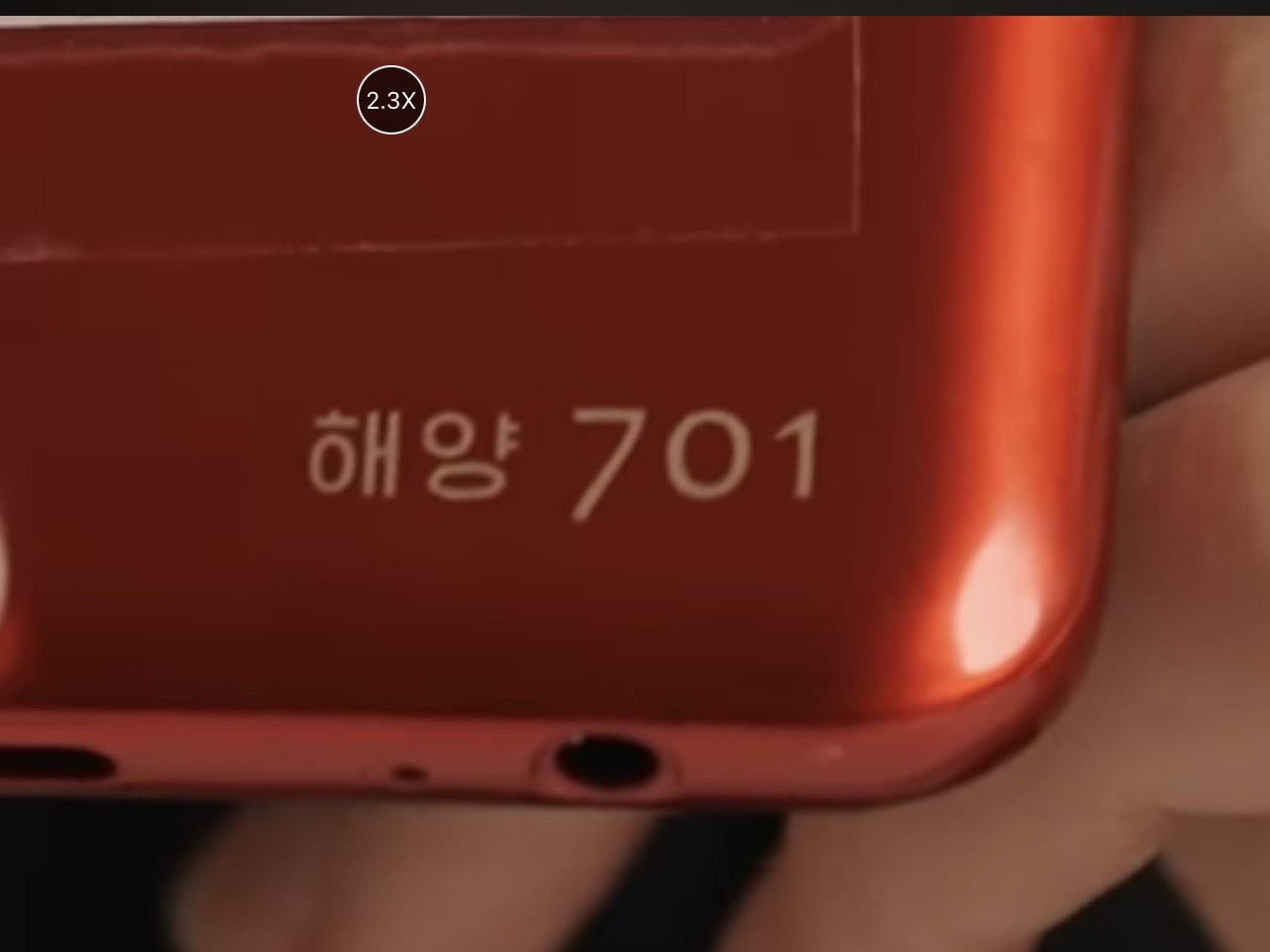
Device reference: NK TechLab, Smartphones of North Korea 2026, p. 25 ↗
The frame shows the history interface. Research on other examined devices establishes that the list can be visible while the captured images remain inaccessible and cannot be erased by the user. Project Reveal, p. 10 ↗
← Back to the Red Star connectionFour entries, fifteen minutes
Four consecutive entries in the evening frame share an application title and the date 2024.5.19. What interval separates them?
Select an interval, then compare the inference with the evidence.
An ordinary evening, kept on file
A home screen. A game. Another timestamp. The entries are ordinary; their persistence is the point. The device keeps an account of activity that its user cannot simply erase.
The list gives us labels and times. It does not show the captured images themselves or tell us what the person thought, typed or intended.
The date is also a clue
The history frames display Gregorian dates from 2023–24. A screen from before 2025 need not use Juche dating. Read the calendar that is actually present, and distinguish a device’s displayed date from the date a recording was made.
Different devices, different capture patterns
This is a general lesson about open-source research on closed systems, and the same one Module 03 of the earlier deck makes about dated screenshots. Every finding is a photograph of one device at one moment. The honest sentence names the device and the year; the dishonest one says "North Korean phones do X".
The Haeyang demonstration also describes automatic emphasis of Kim Jong Un’s name. Module 03 examines that frame alongside word suppression and normalisation, distinguishing visible text from the action reported in the narration.
What connection costs
Why this matters
Sources used in this module: Martyn Williams and Niklaus Schiess, Project Reveal, Lumen with ERNW, 2022, for NATISIGN and SELFSIGN and the Trace Viewer behaviour; Florian Grunow, Niklaus Schiess and Manuel Lubetzki, "Woolim: Lifting the Fog on DPRK's Latest Tablet PC", 33C3, 27 December 2016, and Martyn Williams, 38 North, 3 March 2017, for the tablet mechanisms; Martyn Williams, Smartphones of North Korea, Lumen and NK TechLab, 2024 and 2026 editions, for confirmation on later handsets; Martyn Williams, "A Look at North Korean Cellular Charges", NK TechLab, 25 February 2026, for the Kangsong tariff grid and the Myohyang and Madusan handset prices; BBC and Daily NK on the 2025 Samtaesong handset. The five-minute interval is specific to that 2025 device.
The word the phone will not let you type
On 18 January 2023 North Korea passed the Pyongyang Cultural Language Protection Act: five chapters, sixty-five articles, criminalising South Korean vocabulary, grammar, writing style and intonation. Article 19 bans "puppet-style" address terms and requires 동지 or 동무 instead. Article 22 bans the rising phrase-final intonation. Two years later, a handset examined in Pyongyang carried the Act as a piece of software: a 괴뢰말 제거 프로그람, a puppet-speech removal program, running inside the messaging app.
The next screen is that program. Type into it.
괴뢰말 제거 프로그람
Tap a word to drop it into the message box, then press 보내기. The phone will decide whether to let it through. Everything happens in your browser; nothing is transmitted.
The keyboard has an editor
Emphasis, suppression and normalisation do different work. These stills show the writing surface; the demonstration’s narration describes the automatic actions.
Source: supplied video stills of the Haeyang 701 demonstration. Each panel distinguishes the visible text from the reported change; these are not screenshots of Red Star or of the Samtaesong handset used elsewhere on this page.
Two syllables in a system dialog
Open the locked album. The dialog that appears is the one photographed on the smuggled handset, and it contains a grammar lesson in its second syllable pair.
금지되였습니다kŭmjidoeyŏssŭmnida"has been forbidden"
A Seoul phone would print 금지되었습니다. For verb stems ending in ㅣ, ㅐ, ㅔ, ㅚ, ㅟ or ㅢ, the South takes the ending -어 and the North takes -여. It is one of the oldest divergences in the taxonomy, settled in the 1966 norms, and it is sitting in a system error message about a locked screenshot folder.
The folder is locked because it holds the Trace Viewer captures from Module 02. The grammar rule and the surveillance mechanism are in the same dialog box.
What you can now read
One honest counterweight to carry away. The reason the Act exists at all is that the divergence was closing, not widening: an estimated 70 to 80 per cent of the jangmadang generation has watched South Korean media, and Southern slang and address terms have travelled north with it. A law that has to ban 오빠 is evidence that people were saying 오빠.
Sources used in this module: 문동희, "북한 스마트폰 메시지 앱에 한국식 표현 '오빠' 입력해보니…", Daily NK, 22 January 2025, for the 괴뢰말 제거 프로그람 and the verbatim warning string; Daily NK's published text of the Pyongyang Cultural Language Protection Act, passed 18 January 2023, for Articles 19 and 22; Asia Economy, 3 June 2025, and BBC footage of the same handset for the further substitutions and the locked-album dialog, the latter read from a lower-quality repost and therefore carried at medium-high confidence; The Korea Times, 2 July 2021, for the jangmadang generation estimate and the Thae Yong-ho figure; the grammar rules from this project's Korean language variation taxonomy.